Whitepaper
The Business Case for Modern Partner Enablement
From Cost Center to Revenue Engine
February 13, 2026



Key Takeaway:
Channel partners influence 75% of B2B transactions, yet most organizations treat enablement as a cost center. The data proves otherwise: trained partners generate 6x more revenue, close deals 2.8x more often, and deliver 296-490% ROI. This whitepaper shows what high-performers do differently—treating enablement as revenue infrastructure, leveraging AI-powered platforms, and connecting training directly to business outcomes.
Executive Summary
Your partners are leaving money on the table. Most of the time, it's not their fault.
Channel partners now influence 75% of B2B transactions. Yet most organizations treat partner enablement as an afterthought—a cost center buried in operations, not a revenue engine driving growth.
The result? Inconsistent sales performance, six-month ramp times, and millions in unrealized revenue.
The data tells a different story for companies that get this right.
Key Findings:
- Partners who complete training generate 6x more revenue than those who don't [1]
- Partner-attributed deals close 2.8x more often and are 32% larger [2]
- Companies with mature enablement programs see 296-490% ROI on platform investments [3]
- Organizations with channel-first strategies shortened sales cycles by 25% in 2024 [4]
- Modern enablement platforms reduce partner onboarding time by 40-52% [5]
The Bottom Line:
Partner enablement isn't a support function. It's strategic infrastructure that directly impacts revenue, deal velocity, and competitive position.
Companies that build these capabilities now will capture a disproportionate share of the $80 trillion partner ecosystem economy projected by 2030 [6]. Those that don't will watch their competitors win the deals they should have closed.
This paper shows you exactly what high performers do differently—and how to close the gap.
The Hidden Revenue Leak in Your Partner Program
Here's something I've seen over and over in my years working with enterprise organizations: companies invest heavily in recruiting partners, then leave them to figure things out on their own.
It rarely works.
Partners now influence three-quarters of all B2B transactions [7]. But influence doesn't automatically translate to performance.
Most channel managers spend 15 hours per week answering basic questions their partners should already know [8]. Product specs. Competitive positioning. Pricing details. Implementation basics.
That's nearly half their working week on information that should be accessible in seconds.
The problem isn't partner motivation. Your partners want to succeed. They have their own revenue targets, their own businesses to grow. When they sell your product effectively, they win too.
The problem is that most organizations don't give partners the tools to succeed.
📊 THE REALITY CHECK
- 75% of B2B transactions flow through partners [7]
- Only 33% of companies have formal partner education programs [9]
- 15 hours/week spent by channel managers answering basic partner questions [8]
The gap between partner potential and actual performance represents millions in unrealized revenue.
Think about your own program. How long does it take a new partner to close their first deal? Three months? Six months? Longer?
Now think about what that delay costs you. Every week a partner spends ramping up is a week they're not generating revenue. Multiply that across your entire partner network. The numbers add up fast.
And it's not just new partners. Product updates. New competitive threats. Shifting market conditions. Your partners need continuous access to current information—not quarterly webinars that are outdated by the time they're scheduled.
The partners who succeed are the ones who can answer customer questions confidently, position against competitors accurately, and close deals without constantly calling your team for help. The question is: are you making that possible?
The Real Cost of Under-Enabled Partners
Let's put some numbers behind this.
PartnerStack analyzed revenue data across their B2B SaaS network and found something striking: partners who complete training or certification earn 6x more revenue than those who don't [1].
Not 20% more. Not double. Six times.
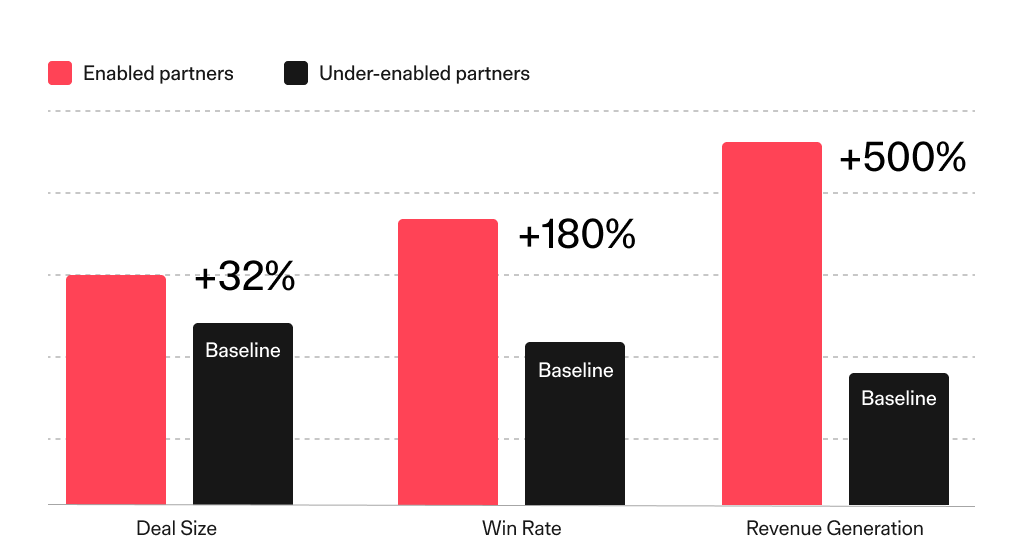
That's the difference between a partner who closes one deal a quarter and one who closes six. Between a partner who barely covers their overhead and one who's actively expanding their team to handle your products.
The gap shows up everywhere in the data:
| Metric | Enabled Partners | Under-enabled Partners |
|---|---|---|
| Revenue generation | 6x higher [1] | Baseline |
| Win rate | 2.8x higher [2] | Baseline |
| Deal size | 32% larger [2] | Baseline |
| Sales cycle | 25% shorter [4] | Longer/unpredictable |
| Support burden | Self-sufficient | Constant hand-holding |
Look at that win rate difference. Partner-attributed deals close nearly three times more often than non-partner deals [2]. Why? Because partners bring relationships, local knowledge, and industry expertise that your direct team can't replicate at scale.
But only when they know your product in and out.
When partners lack product knowledge, they avoid selling complex solutions. They default to safe, small deals—or worse, they prioritize a competitor's product because they understand it better.
Your product becomes their backup option, not their go-to recommendation.
📋 IN PRACTICE: The Microsoft Ecosystem
The multiplier effect in action: For every $1 of Microsoft vendor revenue, service-led partners generate $8.45 and software-development partners generate $10.93 [10].
That multiplier only works when partners have deep product knowledge and selling skills. Without enablement, it collapses.
This is why Microsoft invested billions in partner education infrastructure. They understand that their success is completely dependent on partner success.
Here's what under-enabled partners actually cost you:
Lost Revenue: Partners who can't articulate your value proposition lose deals to competitors who can. Every lost deal is revenue that walked out the door.
Longer Sales Cycles: Partners who don't understand your product can't answer customer objections. Deals stall while they "get back to you" on basic questions.
Support Burden: Your team picks up the slack. Channel managers become help desks. Support tickets pile up. Technical resources get pulled into presales conversations.
Partner Churn: Partners who can't succeed with your product don't stick around. They prioritize vendors who make it easier to sell. You spend time and money recruiting replacements for partners who left because you didn't enable them properly.
The cost of inaction isn't zero. It's massive and compounding.
What High-Performing Partner Programs Do Differently
I've seen partner programs that generate 10% of company revenue with a one-person team. I've seen others with entire departments that struggle to move the needle.
The difference isn't headcount. It's infrastructure.
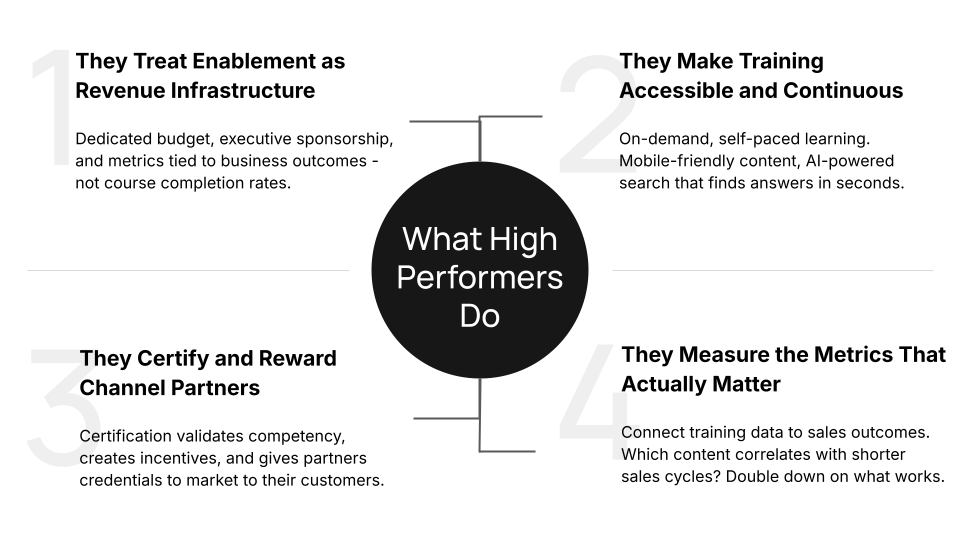
High-performing partner programs share four characteristics:
1. They Treat Enablement as Revenue Infrastructure
This isn't semantic. The companies that win don't file partner training under "operations" or "support." They treat it as a direct investment in revenue growth—with dedicated budget, executive sponsorship, and metrics tied to business outcomes.
When I talk to channel leaders at companies like GoPro or Clear, they don't measure success by course completion rates. They measure partner-sourced revenue, deal velocity, and time to first sale.
The difference in mindset produces wildly different outcomes.
2. They Make Training Accessible and Continuous
Annual partner conferences and quarterly webinars don't cut it. Your partners need information when they need it—during a sales call, before a customer meeting, while preparing a proposal.
That means on-demand, self-paced learning. Mobile-friendly content they can consume on their schedule. AI-powered search that finds answers in seconds, not hours.
The partners who succeed are the ones who can get just-in-time answers without leaving their workflow.
3. They Certify and Reward
Certification programs do three things: they validate partner competency, they create incentives for training completion, and they give partners credentials they can market to their own customers.
The data backs this up.
Gusto Academy found that certified partners bring in 40% more clients within 90 days of certification [11]. Partners who completed the People Advisory Certification grew their payroll revenue 3x-15x [11].
That's not a marginal improvement. It's a complete transformation of partner economics.
4. They Measure What Matters
The old metrics—courses completed, login frequency, quiz scores—don't tell you much. High performers connect training data to sales outcomes.
Which partners who completed certification are actually closing more deals? Which content correlates with shorter sales cycles? Which programs produce the highest ROI?
Without that visibility, you're flying blind. With it, you can double down on what works and cut what doesn't.
📋 IN PRACTICE: Apollo
Apollo's partner program contributes 10% of total company revenue—managed by a one-person team with 4,000 partners [12].
How? Complete automation of onboarding, training, and payouts. The key was investing in infrastructure that scales without proportional headcount.
One person. 4,000 partners. 10% of company revenue.
That's what the right infrastructure makes possible.
The Technology Gap: Legacy Systems vs. Modern Platforms
You can't scale partner enablement with spreadsheets, PDFs, and quarterly webinars.
But you also can't succeed with the wrong technology.
This is where I see companies stumble. They recognize they need a platform, so they buy an enterprise LMS built only for internal compliance training. Then they wonder why partners don't use it.
The problem is fit. Legacy systems designed for employee training often fail miserably for external audiences.

Look at that engagement gap. Modern platforms achieve 99% engagement compared to 11% industry average for legacy tools [14].
That's not a rounding error. It's the difference between a platform partners actually use and one they avoid.
When partners can't access training easily, they simply won't engage. And partners who don't engage don't sell. It's that straightforward.
The user experience matters more than most channel leaders realize. Your partners aren't captive employees who have to use whatever system you provide. They're independent businesses who can choose to prioritize your products—or not.
If your learning platform is harder to use than YouTube, you've already lost.
The Integration Problem
Legacy systems also create data silos. Training happens in one system. Deal registration in another. CRM in a third. None of them talk to each other.
So when you want to know if your certification program actually improves sales performance, you're exporting spreadsheets and doing manual analysis. By the time you have answers, the data is stale.
Modern platforms integrate natively with CRM, PRM, and communication tools. Training completion triggers workflows. Certification status appears on partner records. You can see, in real time, the connection between learning and revenue.
That visibility is what allows you to optimize continuously instead of guessing.
AI-Powered Enablement: The New Competitive Baseline
Here's what's changed in the last two years: AI has moved from "nice to have" to "competitive necessity" in partner enablement.
The numbers are striking. 95% of customer education teams plan to leverage AI within the next 12-18 months [15]. Organizations using AI-powered training see a 30% reduction in time spent managing programs and 45% increase in efficiency [16].
But here's what matters most for partners: AI enables just-in-time knowledge access that was impossible before.
Think about what your partners actually need. They're on a sales call. The customer asks about competitive differentiation. The partner needs an answer now—not after logging into a portal, searching through folders, and hoping to find the right document.
AI-powered learning agents change this completely.

Partners ask a question in natural language—through Slack, Microsoft Teams, SMS, or directly in Continu. They get an instant answer pulled from your knowledge base: competitive positioning, product specs, pricing details, implementation requirements.
No searching. No waiting. No calling your team for help.
📊 THE AI ADVANTAGE
- 95% of education teams plan to leverage AI within 12-18 months [15]
- 30% reduction in training management time with AI-powered platforms [16]
- 45% increase in training program efficiency [16]
- 26% higher retention with AI-driven personalization [17]
AI isn't replacing partner training. It's making it accessible in the moment of need.
Beyond Search: Personalized Learning at Scale
AI also enables personalization that was previously impossible without massive teams.
Different partners need different things:
- A technical implementation partner needs deep product architecture training.
- A referral partner needs enough knowledge to identify opportunities and make introductions.
- A reseller needs full sales enablement with competitive positioning and objection handling.
With AI-powered segmentation, the platform automatically delivers the right content to the right partner based on their role, their history, and their performance data. No manual curation required.
This is how you scale enablement without scaling headcount. The system does the work of targeting, recommending, and following up. Your team focuses on strategy, not administration.
The Competitive Reality
If your competitors are using AI to make their partners faster and more effective, and you're still relying on static content libraries and scheduled webinars, you're falling behind.
Partners notice. They'll prioritize the vendors who make them successful. The vendor with instant answers beats the vendor with "let me get back to you" every time.
Building an Enablement Strategy That Scales
Let's get practical. What does a scalable enablement strategy actually look like?
I've found it helps to think in terms of four pillars:
Pillar 1: Structured Onboarding
The first 90 days determine whether a partner becomes productive or goes dormant.
High-performing programs don't dump partners into a generic training library and hope for the best. They create clear learning paths from day one: product knowledge, sales skills, certification tracks.
The goal is reducing ramp time—getting partners to their first deal faster. Companies using structured onboarding report 40-52% reduction in ramp time [5]. That's real revenue acceleration.
Pillar 2: Continuous Learning
Onboarding is just the beginning.
Products change. Competitors evolve. Market conditions shift. Your partners need continuous access to current information—not annual refresher courses that are outdated by the time they're released.
This is where AI-powered knowledge access makes the biggest difference. Partners can ask questions and get answers in real time, drawn from your constantly updated knowledge base.
New product feature? Partners learn about it the moment it's documented. New competitive threat? Partners have your positioning before the next sales call.
Pillar 3: Certification and Credentialing
Certifications validate competency. They also create powerful incentives.
Partners who achieve certification can market those credentials to their customers. "We're a Gold Certified Partner" means something. It differentiates them from competitors and justifies premium pricing for their services.
From your perspective, certification ensures a baseline of quality across your channel. Certified partners close more deals, require less support, and represent your brand more effectively.
Pillar 4: Measurement and Attribution
Everything above is useless if you can't measure the impact.
The key is connecting training data to business outcomes. Not just "how many courses were completed," but "how did certification affect win rate?" Not just "how many partners logged in," but "which training correlates with shorter sales cycles?"

This requires integration between your learning platform and your CRM/PRM systems. Without that connection, you're stuck with activity metrics that don't prove value.
📋 IN PRACTICE: Bolt Business
Bolt Business achieved 30% month-over-month partner-driven revenue growth by systematizing their enablement approach [18].
The formula: structured onboarding, continuous updates, clear measurement of what was working.
No shortcuts. Just consistent execution of fundamentals with the right infrastructure.
Measuring What Matters: Metrics That Tie Training to Revenue
Most partner programs track the wrong things.
Courses completed. Quiz scores. Login frequency. These are activity metrics. They tell you partners are doing something. They don't tell you if it's working.
High performers track leading and lagging indicators that connect directly to revenue:
The 5Cs Partner Scoring Model
This framework helps you evaluate partner health across multiple dimensions [19]:
| Dimension | What it measures | Enablement connection |
|---|---|---|
| Contribution | Revenue and sales volume | Lagging indicator of enablement success |
| Capability | Skills, certifications, and specializations | Direct output of training programs |
| Coverage | Market reach, geographic footprint | Informed by product/vertical training |
| Commitment | Engagement, portal activity, planning | Leading indicator of program health |
| Consumption | Utilization of resources and MDF | Measures enablement adoption |
Leading Indicators
These predict future performance:
- Certification velocity: How fast do partners complete certification tracks?
- Content consumption: Which partners are actively engaging with new materials?
- Portal login frequency: Who's showing up consistently?
- Training enrollment rates: Who's investing time in learning?
Lagging Indicators
These prove value:
- Win rate by certification status: Do certified partners close more deals?
- Deal size by training completion: Are trained partners selling larger solutions?
- Sales cycle by partner tier: Are your best-trained partners closing faster?
- Customer retention from partner deals: Do educated partners deliver better customer experiences?
📊 PROVING ROI
Forrester Total Economic Impact studies document 296-490% ROI from partner enablement platform investments [3].
Key drivers:
- Sales increase of 20%+ from better-trained partners
- Onboarding time reduction of 40%
- Operational efficiency gains from automation
The ROI case for enablement infrastructure is well established. The question isn't "does it work?" It's "how fast can we implement?"
Selecting the Right Enablement Platform
Not all partner enablement platforms are created equal. The right choice depends on your ecosystem complexity, audience diversity, and growth trajectory.
Here's what to evaluate:
Evaluation Criteria
Audience Flexibility Can it serve partners AND customers AND employees? Or is it partner-only?
Partner-only platforms create silos. When your customer success team has product updates to share, they're using a different system than your channel team. Version control becomes a nightmare. Consistency suffers.
Unified platforms let you create content once and deliver it to every audience with appropriate segmentation.
Modern User Experience Will partners actually use it?
This is non-negotiable. Partners have choices. They won't fight through clunky interfaces or hunt for buried content. If your platform isn't as intuitive as the apps they use in daily life, engagement will suffer.
Integration Depth Does it connect to your existing tech stack?
CRM integration is table stakes. The platform should also connect to communication tools (Slack, Teams), PRM systems, HRIS for user provisioning, and video conferencing for virtual training.
AI Capabilities Can partners get instant answers to questions?
AI-powered search and learning agents aren't optional anymore. Partners need just-in-time knowledge access, not static content libraries.
Analytics and Attribution Can you connect training to revenue?
Beyond completion rates, you need the ability to correlate learning data with sales outcomes. That requires integration with CRM data and flexible reporting tools.
Platform Comparison
Here's how the major players stack up:
| Platform | Primary focus | AI capabilities | Multi-audience | Implementation |
|---|---|---|---|---|
| Continu | Unified (partners, customers, employees) | AI Learning Agent (Eddy), Smart Segmentation™ | Yes - all audiences | ~2 months |
| Skilljar | External training (customers, partners) | Limited | Partners + Customers | 3-4 months |
| Thought Industries | Customer education | Basic | Customers + Partners | 3-4 months |
| Impartner | PRM with training modules | Limited | Partners only | 4-6 months |
| Channeltivity | Partner portal/PRM | None | Partners only | 3-4 months |
The key differentiator: most platforms in this space are partner-only. They solve one problem—training external partners—but create another problem: fragmented systems for different audiences.
Continu takes a different approach: one platform for partners, customers, and employees. Single source of truth. Consistent content. Unified analytics.
How Continu Solves the Partner Enablement Challenge
Based on the challenges outlined in this paper, here's how Continu addresses each, and why companies like GoPro, SoFi, and Instacart trust it for their partner ecosystems.
| Challenge | How Continu solves it |
|---|---|
| Partners can't access training easily | Consumer-grade UX, mobile-friendly, 99% engagement rates |
| Partners need answers during sales calls | Eddy AI Learning Agent for instant answers via Slack, Teams, SMS |
| Training disconnected from work | Deep integrations with Slack, Teams, Zoom, Salesforce |
| No visibility into program effectiveness | Continu Insights with AI-powered analytics |
| Can't scale without adding headcount | Smart Segmentation™ and automated workflows |
| Multiple audiences to serve | Unified platform for partners, customers, and employees |
| Content version control nightmare | Centralized content with real-time updates |
| Global programs with language barriers | Multi-language support with localized learning paths |
Eddy: AI Learning Agent
This is where Continu fundamentally differs from competitors.
Eddy is a conversational AI agent that delivers knowledge in the flow of work. Partners ask questions in natural language—through Slack, Microsoft Teams, SMS, or directly in Continu—and get instant answers from your organization's knowledge base.
Competitive intelligence. Product specifications. Pricing details. Implementation requirements. Whatever partners need to learn and sell better, Eddy surfaces it in seconds.
No searching through folders. No waiting for responses. No "let me get back to you."
Your partners become self-sufficient because they have instant access to everything they need.

Smart Segmentation™
Not every partner needs the same content. Smart Segmentation automatically targets training based on partner attributes: role, region, tier, certification status, product focus.
Technical partners see technical content. Sales partners see sales content. New partners see onboarding content. Advanced partners see advanced content.
All automatic. No manual curation required.

Unified Platform Advantage
Most competitors force you to choose: a platform for partners OR a platform for customers OR a platform for employees.
Continu handles all three from one system. Create content once. Deliver it to every audience with appropriate targeting. Maintain one source of truth instead of three.
This isn't just convenient. It's strategically important. Your partners should have access to the same product knowledge as your internal teams. Consistency builds confidence.
📋 IN PRACTICE: GoPro
GoPro uses Continu to train retailers, athletes, and partners across 20+ countries [20].
Results:
- $1M+ in annual productivity savings
- 60%+ seat activation within 60 days
- 186 retailers onboarded with bespoke registration flows
- 8.5/10+ learner satisfaction scores
The platform consolidated global training onto a single system with localized content for each market. Partners access current product knowledge in their language, on their schedule.
What Makes Continu Different
Unified Platform: Train partners, customers, and employees from one system—no fragmented tools
AI-Powered Learning: Eddy delivers knowledge in the flow of work through Slack, Teams, SMS
Enterprise-Ready: SOC 2 compliant, deep integrations, 99.9% uptime
Proven Results: 96% customer satisfaction, 4.8+ star ratings on G2, "Best ROI" recognition
📞 SEE CONTINU IN ACTION
Ready to transform your partner program from cost center to revenue engine?
See how Continu can help you enable partners at scale—and connect training directly to revenue outcomes.
Taking Action: Your Next Steps
Reading about partner enablement won't change your results. Action will.
Here's a practical framework for moving forward:
Step 1: Audit Your Current State
Start with honest assessment:
- What percentage of partners complete training? (Industry average: below 20%)
- How long does partner onboarding take? (If it's 6+ months to first deal, you have a problem)
- Can you connect training data to sales outcomes? (If not, you're flying blind)
- What do your partners say about your enablement resources? (Ask them directly)
Step 2: Quantify the Gap
Put numbers to the problem:
- Calculate revenue lost to under-enabled partners (compare trained vs. untrained partner performance)
- Estimate time your team spends on questions partners should answer themselves
- Model the ROI of improved enablement using the benchmarks in this paper
Step 3: Define Success Metrics
Decide what you'll measure:
- Leading indicators: Certification velocity, content consumption, engagement rates
- Lagging indicators: Win rate by partner tier, deal size, sales cycle length
- Revenue attribution: Partner-sourced vs. partner-influenced revenue
Step 4: Evaluate Platform Options
Use the criteria from Section 8:
- Prioritize unified platforms over point solutions
- Require AI capabilities for just-in-time knowledge access
- Demand CRM integration for attribution
- Weight implementation speed heavily—18+ month implementations are deal-breakers
Step 5: Build the Business Case
Use the data in this paper:
- 6x revenue differential between trained and untrained partners
- 296-490% ROI documented by Forrester studies
- 40-52% onboarding time reduction with modern platforms
- 2.8x higher win rates for partner-attributed deals
Present this to revenue leadership, not just L&D. Position enablement as growth infrastructure, not training overhead.
📊 WHERE THESE STATS COME FROM
The statistics in this whitepaper are drawn from Continu's comprehensive research report: "Partner Enablement Statistics and Trends (2023-2026)"
This 21,000+ word compendium includes data from Forrester, Gartner, McKinsey, IDC, ICONIQ Growth, PartnerStack, Intellum, and other authoritative sources.
Conclusion
Partner ecosystems will drive $80 trillion in annual revenue by 2030—one-third of total global economic activity [6].
The companies that capture their share won't be the ones with the best products. They'll be the ones with the best-enabled partners.
The data is clear:
- Trained partners outperform untrained partners by 6x.
- Certified partners close 40% more deals.
- Companies with mature enablement programs see triple-digit ROI.
This isn't theory. It's documented business reality.
The question for your organization is simple: Will you invest in the infrastructure that makes partner success inevitable? Or will you keep hoping that quarterly webinars and PDF libraries will somehow close the gap?
The companies that move now will have a head start their competitors can't easily overcome. The companies that wait will wonder why their channel results keep disappointing.
Partner enablement isn't a cost center. It's a revenue engine.
It's time to treat it that way.
Sources Cited
[1] PartnerStack, "2023 SaaS Channel Partnership Report." Partner Survey Data on Training Impact.
[2] Introw, "Partner Deals Have a 32% Bigger Deal Size and 2.8X Higher Win Rate," January 2024.
[3] Forrester Research, "Total Economic Impact Studies" - Absorb LMS (490% ROI), Impartner (296% ROI), 2024.
[4] ICONIQ Growth, "Leveraging Channel Partnerships to Reignite Growth," 2024.
[5] Intellum, "How Partner Training Increases Sales and Efficiency," October 2023; Continu, "How TKWW Drove Engagement with Continu" Case Study.
[6] McKinsey & Company, "Ecosystem Projections and Channel Transformation Research."
[7] SP_CE, "A Guide To Channel Sales Success," 2025.
[8] SP_CE, "A Guide To Channel Sales Success," 2025. Channel Manager Time Allocation Data.
[9] Intellum, "How Partner Training Increases Sales and Efficiency," October 2023.
[10] IDC, "Microsoft Partner Ecosystem Study on Partner Profitability."
[11] Intellum/Gusto Academy, "How Partner Training Increases Sales and Efficiency," October 2023.
[12] PartnerStack, "Revenue-Driving Partnerships in Action: Real-World Case Studies," 2025.
[13] Continu, "Comparing Continu vs Cornerstone OnDemand."
[14] Continu, "Customer Performance Data and Industry Benchmarks."
[15] Intellum, "2024 Trends in Customer & Partner Education and Enablement."
[16] Gartner, "AI-Powered LMS Implementation Analysis," 2024.
[17] LearningOS, "AI-Driven LMS Research and Statistics."
[18] PartnerStack, "Revenue-Driving Partnerships in Action: Real-World Case Studies," 2025.
[19] Spur Reply, "5 Reasons Why PERC Partner Scoring Gives You an Advantage."
[20] Continu, "How GoPro Scaled Global Customer and Partner Training" Case Study.
Smarter training. Stronger teams.
See how thousands of enablement leaders around the world are automating delivery, increasing ROI, and creating real business impact with Continu.