Visibility you have to ask a subsidiary for is not visibility

VP of Product & Customer Success
September 22, 2026



Parent companies fix subsidiary training visibility by building a rollup report. The report arrives, the answer does not. Visibility is an access problem, and no dashboard stacked on separate systems solves it.
Before Continu, Booking Holdings ran corporate learning on a separate system per brand: Booking.com, Priceline, Kayak, OpenTable, Agoda. When compliance and learning teams needed a group-level picture, it took outside BI support to stitch together what no single platform could show.
You have a dashboard. It refreshes overnight, it shows a completion percentage for every sub-company, and it is not the problem. It is also not the solution.
Each business in the portfolio runs its own learning system, so corporate cannot see across them. Every vendor in this market says so, and they are right.
What you do next is the part worth arguing about. You pipe completion data out of each subsidiary into a warehouse, put a reporting layer on top, and build the rollup. Your data team knows how. Every compliance reporting vendor sells it. It produces a number on a schedule, and the number is real. Then somebody asks a question the number cannot answer, and you find out you bought a report when what you needed was a way in. Parent-level visibility into subsidiary training is an access problem, not a reporting problem, so no dashboard built on top of separate systems will answer the question you are actually asking.
You already have the numbers. You still cannot answer the question.
Say one sub-company sits at 71 percent on a required course. You know the number. Now try to act on it.
You cannot name the people in the other 29 percent. You cannot say whether they are in scope, because scope is configured inside that business's own system by an admin you have never met. You cannot say when each person fell out of currency, or whether the requirement changed underneath them in March. And you cannot produce the record for any one of them without asking somebody there to go and get it.
Three questions, then, that a rollup structurally cannot answer:
- Who specifically
- Since when
- On whose authority
A metric summarizes a system's state. An answer is a named person, a date and a document. That gap is not a data quality issue better pipelines will close, because what you need was never in the pipe.
If you have built a group view of training for audiences outside your own payroll, you know how much of that work is permission rather than plumbing. Across independent businesses, the ratio gets worse.
A rollup is only comparable if the definitions underneath it are.
Complete. Current. Required. In scope. Each is configured locally, by whoever set up that sub-company's instance.
Roll them up and the result looks comparable. It is not. If you run a holding company or a portfolio you have lived this: an operating partner asks one question across a dozen businesses and gets back a blended figure assembled from a dozen local definitions of what counts. Presentable, not decision grade. In diligence the unit of evidence is the entity, and the standards your own reporting is judged against already work that way. The PCAOB has auditors scope internal control testing at individual locations and business units rather than accept a consolidated assertion (AS 2201, Appendix B). Disclosure rules push the same direction: a parent's consolidated sustainability statement covers every subsidiary in the consolidation scope, with the training disclosure specified down to the arithmetic (ESRS S1-13). A prescribed formula is unforgiving of local definitions, which is the whole difficulty.
Booking Holdings makes a clean case, because those brands really are independent. Each runs its own market and its own way of working, while corporate compliance applies to all of them. Force them onto one shared system and you trade a spend problem for a brand autonomy problem. Leave each on its own and corporate stays blind. The rollup looks like the way out of that trade. It is not.
| What corporate asked | What a rollup returns | What it still takes |
|---|---|---|
| Are we current across the group? | One blended percentage | Each brand confirming what current means locally |
| Which people are not covered? | A gap size, not a list | A request to every brand's admin |
| Show me the record | Nothing | Someone with access to that brand's own system |
An audit trail does not survive aggregation.
Aggregation is the operation that discards the evidence chain. Who completed what, on what date, against which version of the policy, with what record attached: none of it survives the trip up. A percentage summarizes evidence rather than being it.
Gaming portfolios hit this wall first, which makes them worth watching if you run a regulated group. Casinos above the revenue threshold are financial institutions under the Bank Secrecy Act, and each must maintain a written anti-money laundering program whose named components include training for appropriate personnel (31 CFR 1021.210). That obligation attaches to the property. So does the evidence.
When internal audit or a regulator arrives, nobody asks for the network completion rate. They ask about one named person, one requirement, one date, and the record behind it. Your rollup cannot produce that. Someone opens that property's own system and pulls it by hand, which is the original gap restated rather than solved, now with a regulator waiting.
Keep the distinction between a report and a record. A report is generated, and can be regenerated differently tomorrow. A record is retained, timestamped and attributable. Only one holds up in a review, and your reporting layer produces the other one.
Visibility you have to ask for is a reporting relationship.
The mechanism, plainly: if your access to a sub-company's training state depends on that sub-company running a report and sending it to you, you do not have visibility. You have a dependency and a service level expectation. Reasonable things to hold with a vendor. Strange things to hold with a business you own.
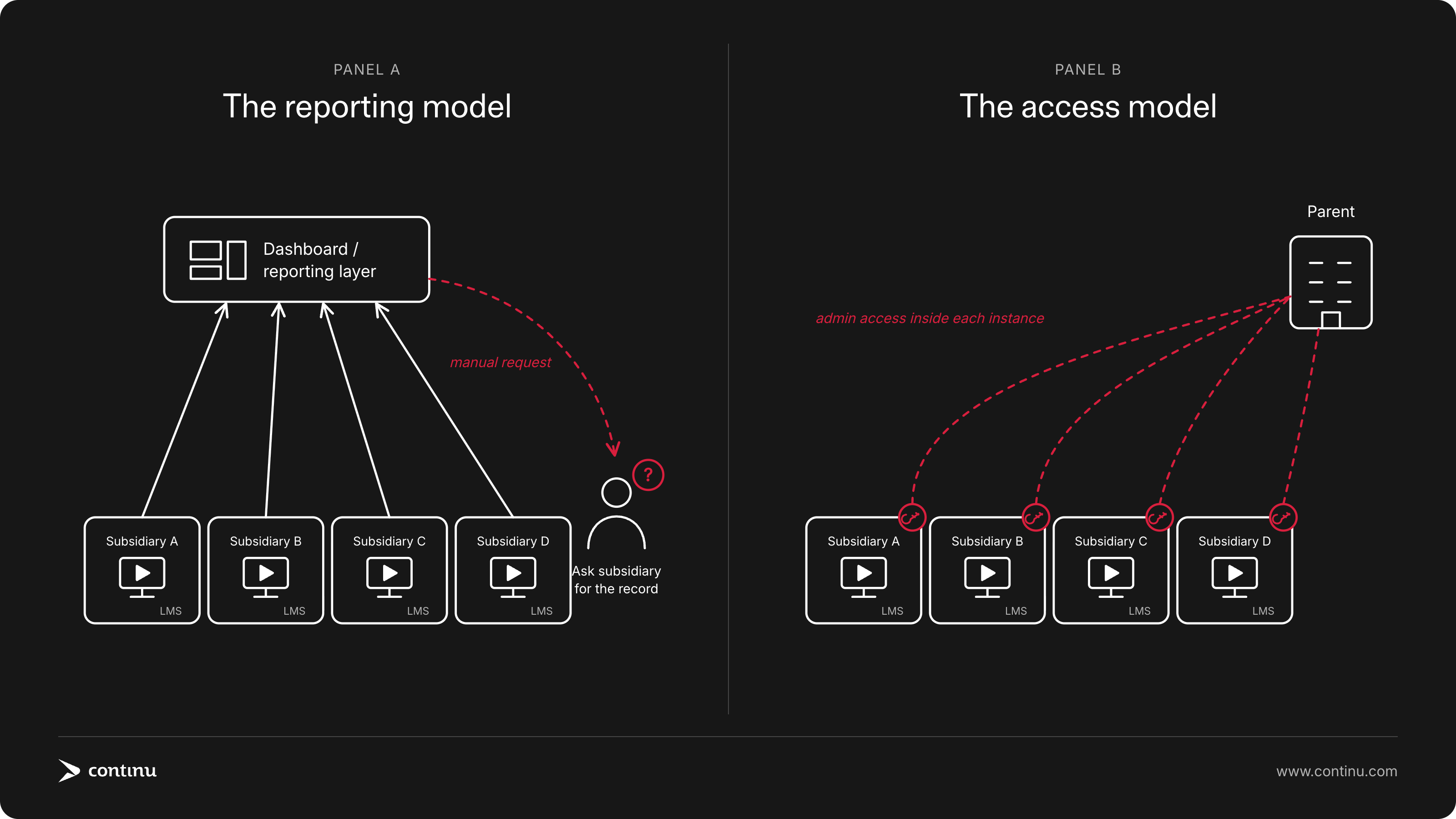
The reporting model pipes data up into a dashboard and still sends someone back down to ask for the record by hand. The access model puts the parent inside each subsidiary's own system natively, with no request required.
The alternative is architectural rather than analytical. Each business keeps its own complete system, and you hold a parent account inside every sub-company's own system: permissioned, audit-logged, able to see network-wide activity natively and to step into any instance without anyone assembling anything first. You are not moving the data. You are changing who is allowed to stand where the data already lives.
Take the objection head on, because it ends this conversation early. Parent access is not a loss of autonomy. Each sub-company keeps:
- Its own admins
- Its own content
- Its own branding
- Its own integrations
- Its own assignment rules
Nobody gets a downgraded instance or a template to live inside. Every cross-company action is logged, which is stronger governance than a parent request answered by an export nobody can reproduce.
"A portfolio of famous, independent brands doesn't need one system forced on all of them. It needs one architecture that lets each brand stay itself, and still lets corporate see the whole picture."
Terri James, VP Product and Customer Success, Continu
When a reporting layer is genuinely the right answer.
Two cases where you should buy the report and stop reading.
The first is portfolio churn. If half of what you hold today will be divested inside three years, or the businesses came with contracts nobody can break, rebuilding learning architecture is the wrong sequence. A vendor-neutral reporting layer survives the churn. Accept its limits and revisit at renewal.
The second is scale. A parent with two or three sub-companies and a light regulatory load may never reach the audit trail wall. When the manual path is one phone call, it beats any project you could run instead.
Both are real, and neither disagrees with the mechanism. They are arguments about timing and size: the problem is not worth fixing yet. Neither claims a reporting layer can produce an evidence chain, because it cannot. If your exposure grows or your holding period extends, the wall is still there, and you will have spent two years building toward it.
What this means for you.
Run this test this week. Pick one required course and one sub-company, and ask for the list of named people who are not current, with the date each fell out of currency and the record behind each one. Time it, and count how many people had to be involved.
If it took more than one person or more than a day, you do not have a reporting problem. Worth pricing alongside it: what a separate system per brand costs you in licensing, administration and security review.
Then take one question into your next renewal. Does each business keep its own complete system, and do you hold a real account inside each one, or are you buying another report.
You already had the numbers. Corporate's group-level picture at Booking Holdings took outside BI support to assemble, because no single platform could show it. That is an access condition, not a reporting gap. Parent-level visibility is something you hold or something you request, and the only version that survives an audit is the one where you open the sub-company's own system and read the record yourself.
Related reading. Post one in this series: the hidden cost of running a separate LMS for every brand. The architecture question underneath both: how one platform handles multiple audiences. And Continu's partner enablement research.
Smarter training. Stronger teams.
See how thousands of enablement leaders around the world are automating delivery, increasing ROI, and creating real business impact with Continu.