The hidden cost of running a separate LMS for every brand

President
September 21, 2026


Fixing LMS sprawl by forcing every brand onto one shared system trades a spend problem for a brand-autonomy problem. Most multi-brand leaders make that trade without ever knowing they had a third option.
The average organization already runs 305 separate SaaS applications, with IT directly managing just 15% of that spend, according to Zylo's 2026 SaaS Management Index. For a company running six brands, that isn't an outlier. It's the starting math.
I was on a prospect call earlier this year with a franchise training director who walked me through their stack. One LMS for corporate onboarding. A separate portal for franchisee certification. A spreadsheet tracking who had actually finished compliance training. Slack for everything that fell through the cracks.
They weren't disorganized. Every piece had been bought by a different person, at a different time, to solve a real problem in front of them. The stack was the residue of ten sensible decisions.
What they said next is the part I keep coming back to. They already knew the fix: put everyone on one system.
That's where most multi-brand leaders land, and it's half right. The duplicate spend is real, and one system does collapse the contract count. But look at what the standard version of that fix quietly asks each brand to hand over. Its branding. Its admins. The local workflows its people already run. Those are the things corporate paid a premium for when it acquired or franchised the brand.
Consolidating every brand onto one shared LMS trades a spend problem for a brand-autonomy problem. Most multi-brand leaders make that trade without realizing they had a choice.
You do have one. It just isn't the one the market usually offers.
The bill nobody adds up
Add up what a multi-brand business spends on training software and the number is almost always higher than anyone expects. Not because any single tool is expensive. Because the same category of software got bought five separate times.
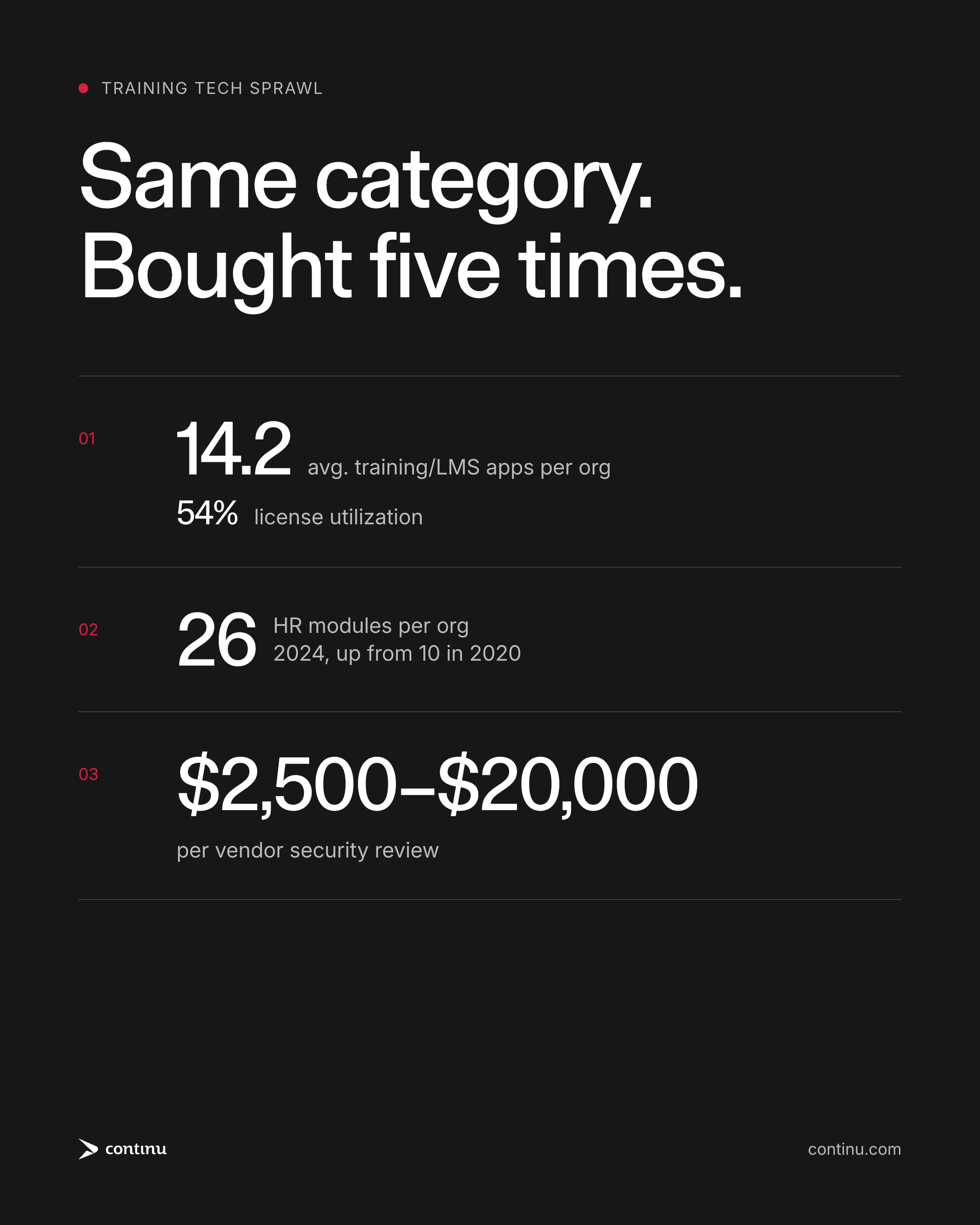
Zylo's 2026 SaaS Management Index puts the average organization at 305 separate SaaS applications, with IT directly managing just 15% of that spend. Training and LMS tools sit inside that sprawl the same as everything else — nobody has a clean read on how much of it is redundant.
The direction of travel is worse than the snapshot. Sapient Insights Group's HR Systems Survey found the average organization now runs about 16 HR systems, up from roughly 10 a few years earlier. Learning sits inside that pile and grows it.
Then there's the cost finance never books against training. Every new vendor a new brand brings triggers its own security review. Pivot Point Security puts a standard manual vendor review at $2,500 to $3,500, rising to $15,000 to $20,000 for a comprehensive onsite audit of a high-risk vendor. That isn't a one-time integration cost. It repeats, per brand, per new vendor.
Same category of software. Five contracts. Five renewal dates. Five vendor relationships. Five admins who rarely talk to each other. Nobody chose that. It accumulated.
| What it costs you | The number | Source |
|---|---|---|
| Training and LMS applications per organization | 305 total SaaS apps per org, IT owns ~15% of spend | Zylo, 2026 SaaS Management Index |
| HR modules per organization | ~16, up from ~10 a few years earlier | Sapient Insights Group, HR Systems Survey |
| One third-party vendor security review | $2,500 to $20,000, by complexity | Pivot Point Security |
Zero visibility, and the fix that costs you the brand you bought it for
Ask a PE-backed holding company how many people across the portfolio completed compliance training last quarter. Someone emails twelve operating companies. Twelve people pull twelve reports in twelve formats. Someone rebuilds the spreadsheet. Two weeks later the firm has a number that went stale while it was being assembled.
Booking Holdings runs Booking.com, Priceline, Kayak, OpenTable and Agoda. Before they came to us, producing a single cross-brand view of training meant bringing in outside BI support just to stitch the picture together, because the underlying systems were never designed to sit next to each other.
The instinct at that point is to force every portfolio company onto one instance. It's the wrong instinct here, for a specific reason. Those brands were bought because they're distinct, and the exit story depends on each one staying operationally distinct enough to sell on its own. Flattening them into sub-portals inside somebody else's account erodes exactly what the firm paid for.
I've never seen a portfolio of independent brands that needed one system forced on all of them. They need one architecture that lets each brand stay itself while corporate sees the whole picture.
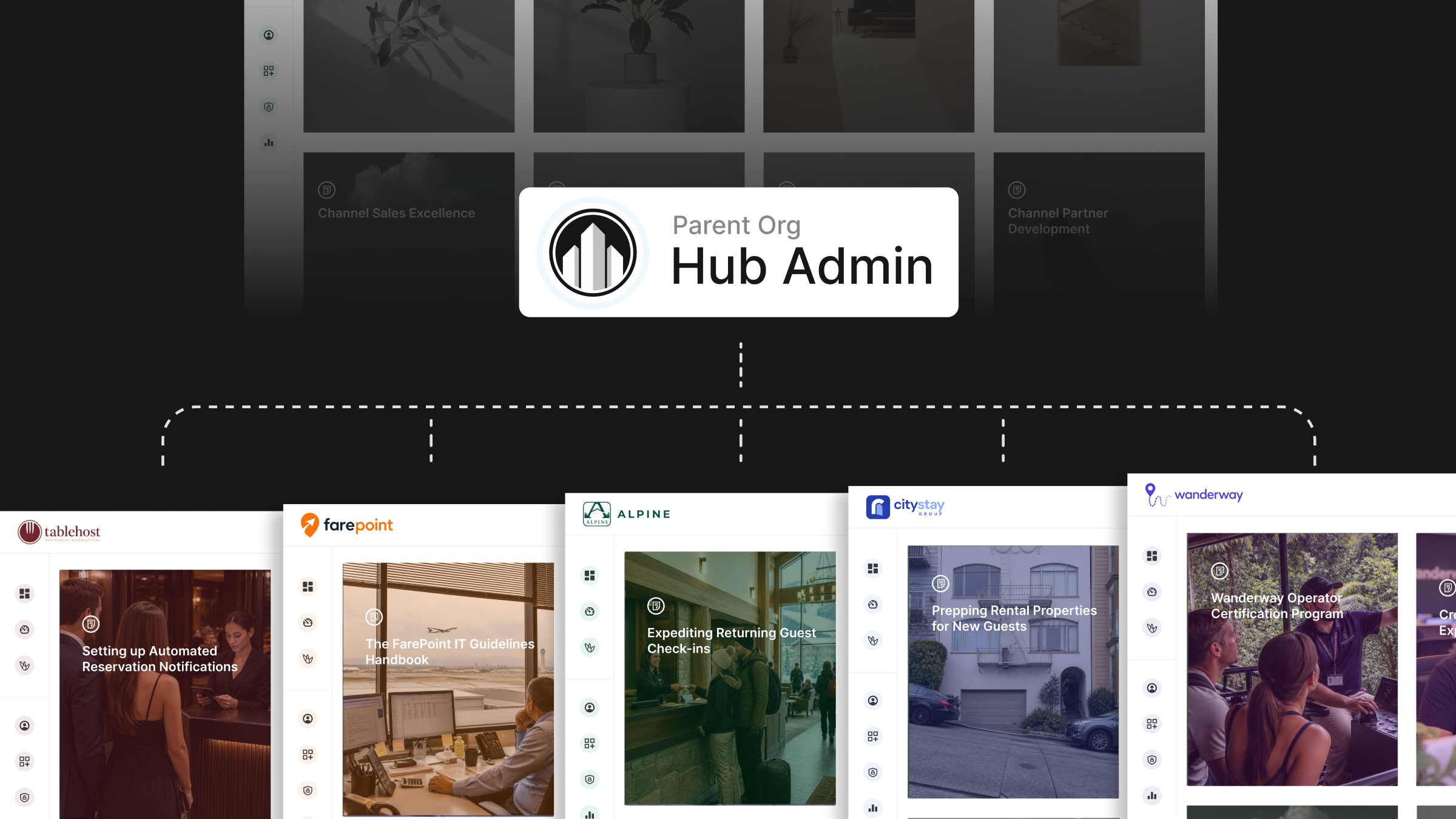
That distinction is the whole design behind Hubs, Continu's parent-portfolio architecture. Every brand runs its own complete instance: its own admins, content library, branding and reporting. The parent gets a real view across all of it without stepping into anyone's day to day.
An audit trail that doesn't roll up
Regulated multi-property operators live with a version of this that has a deadline attached.
Picture a group running several venues or studios under separate brands, each on its own learning system, each with its own compliance record. Every brand is doing the work. Staff get certified. Records exist. Then an internal audit asks for one thing: completion across the whole network, by property, by date. The honest answer is that corporate would have to ask each property to pull its own report, then reconcile formats that were never built to sit side by side.
Notice that nothing has failed. The training happened. What's missing is the rollup, and the rollup is what gets asked for. A compliance position you can only assemble on request isn't a position. It's a hope that every brand handled it.
The gap sharpens when the answer has to be current, not quarterly. Where an untrained employee can't legally work the counter, a completion report from last week says nothing about who can open this morning. Disconnected systems structurally cannot answer that, however well each one runs.
Every new location, another contract
Franchising isn't a niche structure. IFA and FRANdata's 2026 Franchising Economic Outlook counts 832,521 US franchise establishments, employing close to 8.9 million people across more than 300 business-format categories. Each of those units needs consistent training under a shared brand standard, delivered by an operator who isn't on corporate payroll.
Here's how the cost compounds. Open a location, buy training software, train a local admin to run it. Open the next one, repeat. Nobody decides to run five systems. It's what you get when each unit solves its own problem at a different point in time.
Then ask your CISO what Q4 looks like. Different SOC 2 reports to read. Different data processing agreements to redline. Different questionnaires asking the same forty questions in a different order. Multiply that by every brand running its own platform and you've built an audit season around software that was never the risky part of the business.
Consolidating the vendor relationship collapses that cycle. One SOC 2 Type II report. One ISO 27001 certification. One GDPR and CCPA posture to document. One vendor for security to vet properly instead of skimming five.
That's the difference between a real review and five rubber stamps.
When fragmentation isn't worth fixing yet
There's a genuine case against everything above, and it's worth saying.
If you run two or three brands with a light compliance load, the fragmentation tax may be smaller than the cost of fixing it. Three contracts is annoying. It isn't structural. Migrating three systems and retraining three admin teams to recover a manageable amount of overhead is a project with a thin payback.
The same goes for a brand you expect to divest inside eighteen months. Shared infrastructure for an asset on its way out the door has no window to pay back in.
And the model I've been arguing against isn't wrong everywhere. A shared system with a sub-portal per brand works fine when the brands are similar, the compliance load is light, and no brand needs deep local control. It's cheaper, faster to stand up, and it answers the visibility question. What it doesn't do is scale. It strains as soon as brand count grows, or an acquisition arrives with a workflow it was never built to hold.
The question isn't whether fragmentation is bad. It's whether you're close to the point where the usual fix costs more than the problem does.
What this means for you
You don't need a consultant to size this. You need three numbers, and you can have them by Friday.
Count the training systems running across your brands right now. Not the ones on the approved vendor list. The ones people actually log into, including the spreadsheet somebody maintains by hand.
Count the vendor security reviews your team sat through in the last twelve months. Price them against the $2,500 to $20,000 range above, and note how many covered software doing a job you already pay for.
Count the times in the last year corporate asked a brand for a training report that brand didn't already have, and somebody had to go build it.
Once you have the three counts, the Hubs cost calculator will turn them into a dollar figure you can take into a budget conversation.
If any of those numbers is higher than you expected, you've made the fragmentation tax visible. The third one usually matters most, because it's the cost nobody logs and everybody absorbs.
305 apps per org, with IT managing just 15% of that spend, is the industry average, not a worst case. But the choice in front of a multi-brand leader was never fragmentation versus one shared system. Consolidating every brand onto one shared LMS trades a spend problem for a brand-autonomy problem. You can see the whole portfolio without asking a brand to stop being itself.
Related reading: If your problem is audiences rather than brands, see how one platform handles multiple audiences.
Smarter training. Stronger teams.
See how thousands of enablement leaders around the world are automating delivery, increasing ROI, and creating real business impact with Continu.