Oversight Without Override: Centralizing Training Without Killing Brand Autonomy

Founder and CEO
September 23, 2026



Most multi-brand leaders treat oversight and brand autonomy as a trade. Centralize and every brand loses what made it work. Decentralize and you lose sight of all of it. That trade isn't real. It's what the usual fixes cost.
Every fix for fragmented training across a portfolio assumes oversight and autonomy trade off against each other.
They don't.
What trades off is whether every brand sits inside one instance or runs a complete one, and only one of those lets a parent see in without a brand giving anything up.
Two posts into this series, you have both halves of the problem.
Keith Martin made the first case: the cost of running a separate system per brand is real, and it lands on finance, on compliance, and on whoever answers for the whole portfolio.
Terri James made the second: why a rollup report was never real visibility, because reading a number a brand exported for you is not the same as being able to look.
Together they look like a trap.
Fix the first problem by consolidating and you take away what each brand needed to operate.
Fix the second by leaving brands alone and corporate stays blind.
So most leaders stop trying to escape the trade and start managing it.
The sophisticated way to manage it is the one you'll hear from most vendors. Keep one system, but scope it properly: a tenant per brand, its own theme, its own admin roles, and corporate keeps the rollup.
That version fails for the same reason the crude one does. The trade-off between corporate oversight and brand autonomy is manufactured by single-instance architecture, permissions or no permissions, not by any real conflict between the two goals.
The trade-off nobody should have accepted
The market frames this as a balancing act: central control on one side, local execution on the other, and your job is to find the point your brands can live with.
That framing has already conceded the argument.
It assumes the answer sits on a line between two bad options, so the only question left is how much of each you're willing to lose.
Look at what's on that line.
At one end, every brand moves onto one shared system.
Corporate gets its single view, and each brand hands over its branding, its local admins, and the workflows its people run every day.
Resistance follows, and it isn't irrational.
At the other end, every brand keeps buying its own, and nobody at the parent can answer a basic question about training across every brand you own without asking a dozen people to pull numbers by hand.
Then comes the option that presents itself as the mature middle: one system, partitioned, a tenant per brand.
It reads like a resolution.
It isn't.
Every brand is still inside one instance, so autonomy is whatever the platform owner chose to expose.
Fosway Group, an independent European analyst firm, found that more than half of L&D professionals say their learning systems aren't fit for the workforce they support.
That isn't a feature complaint.
It's the shape of the software failing to match the shape of the company.
"Every multi-brand leader we talk to describes the same trap: centralize and you flatten what made each brand work, decentralize and you lose the ability to see anything. That's not a trade-off. It's what happens when the platform makes you choose."
Scott Burgess, CEO, Continu
What a franchise network loses without real enforcement
Start at the autonomy end of that line, because it's the end that looks harmless.
A franchise network has brand standards on paper and no way to see whether anyone follows them.
One location's onboarding drifts, not dramatically and not on purpose: a step gets dropped because it's slow, a manager rewrites a module to match how the site actually runs, and the version being taught stops matching the one corporate approved.
Nobody finds out from the training system, because corporate has no way into it.
They find out somewhere worse.
A complaint that traces back to a procedure nobody was taught.
An inspection.
A claim where the question is what training this operator had and on what date, and the honest answer is that the franchisee would have to go and look.
That's the failure mode of full local control with no enforcement.
The network didn't lack standards.
It lacked any way to know whether they survived contact with the people running the locations, and the gap was a year old before anyone saw it.
What a holding company loses without shared infrastructure
Now the other end.
A portfolio of a dozen brands, each acquired for what made it distinct, each running the system it ran the day you bought it.
Nothing connects.
Corporate can't answer the simplest cross-portfolio question, the kind a board member asks in passing, without sending twelve requests and waiting for twelve spreadsheets built to twelve definitions of a completion.
Terri's post already took apart the fix people reach for here, so I won't re-argue it: a rollup assembled out of disconnected systems tells you what each brand chose to send, when they got round to sending it.
What I'd add is that the blind spot isn't the only cost.
Every brand is also paying, separately, for a floor they could have shared: its own contract, its own admin overhead, its own security review, none of which buys the parent anything it can use.
That's the failure mode of full local operation with nothing shared underneath it.
Both ends of the line lose.
They just send the bill to different people.
The architecture that resolves both
Both failures have one cause.
In every model on that line, the parent's account is not a real account inside the brand's own environment.
It's an admin role in one shared system every brand was moved into, or an email address asking someone else for a file.
A federated model changes that one thing, and the idea isn't new: Training Industry, an independent research organization, named the model in 2023.
One parent instance sits above any number of independent, full-featured brand instances.
Reporting rolls up.
Shared content pushes down.
Corporate builds a compliance course once and distributes it everywhere.
At Continu, that is Hubs, the federated architecture built for this.
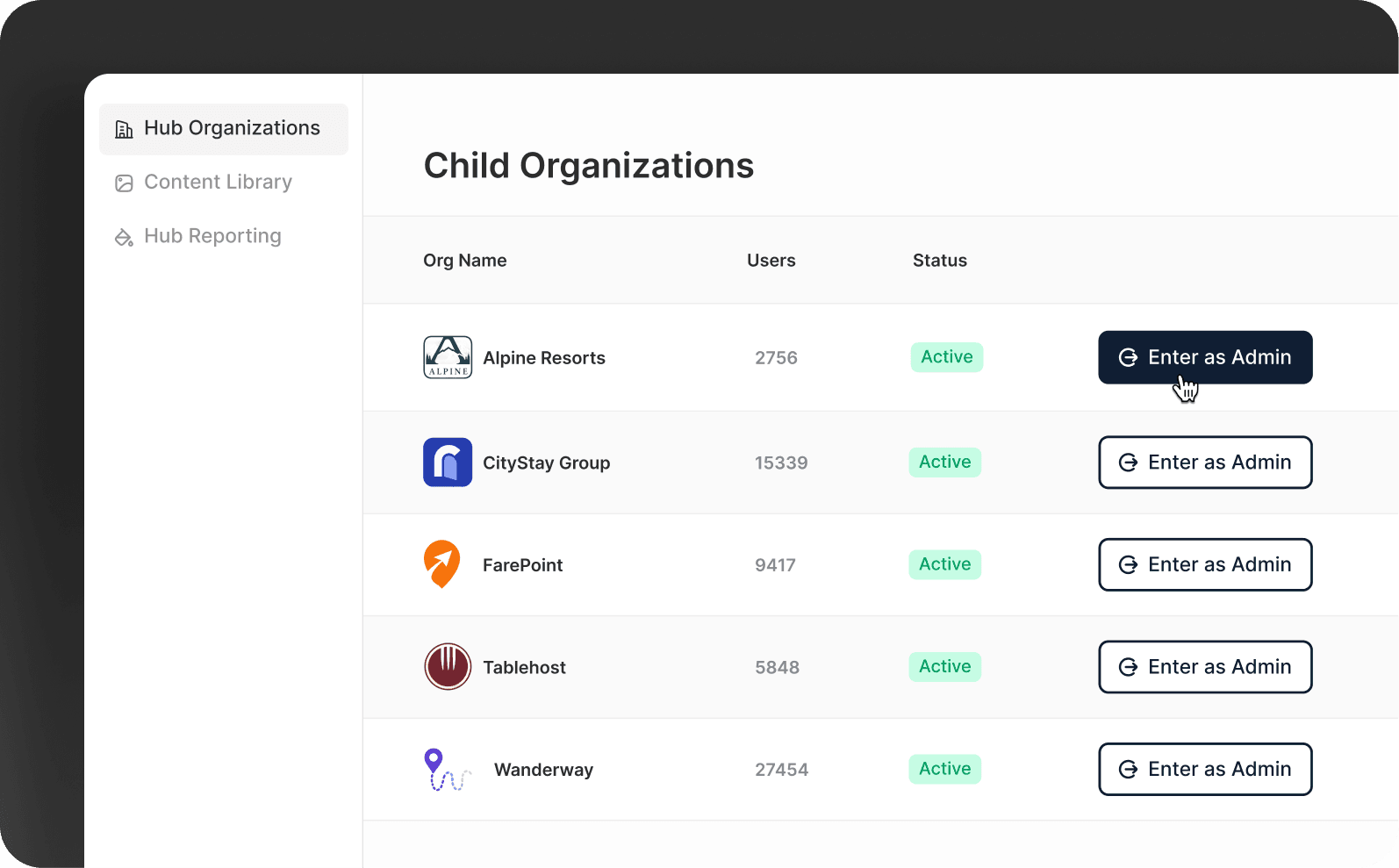
What corporate gets is access instead of a request queue. An admin moves from the parent into a brand's own instance directly, audit-logged, and looks at what's there.
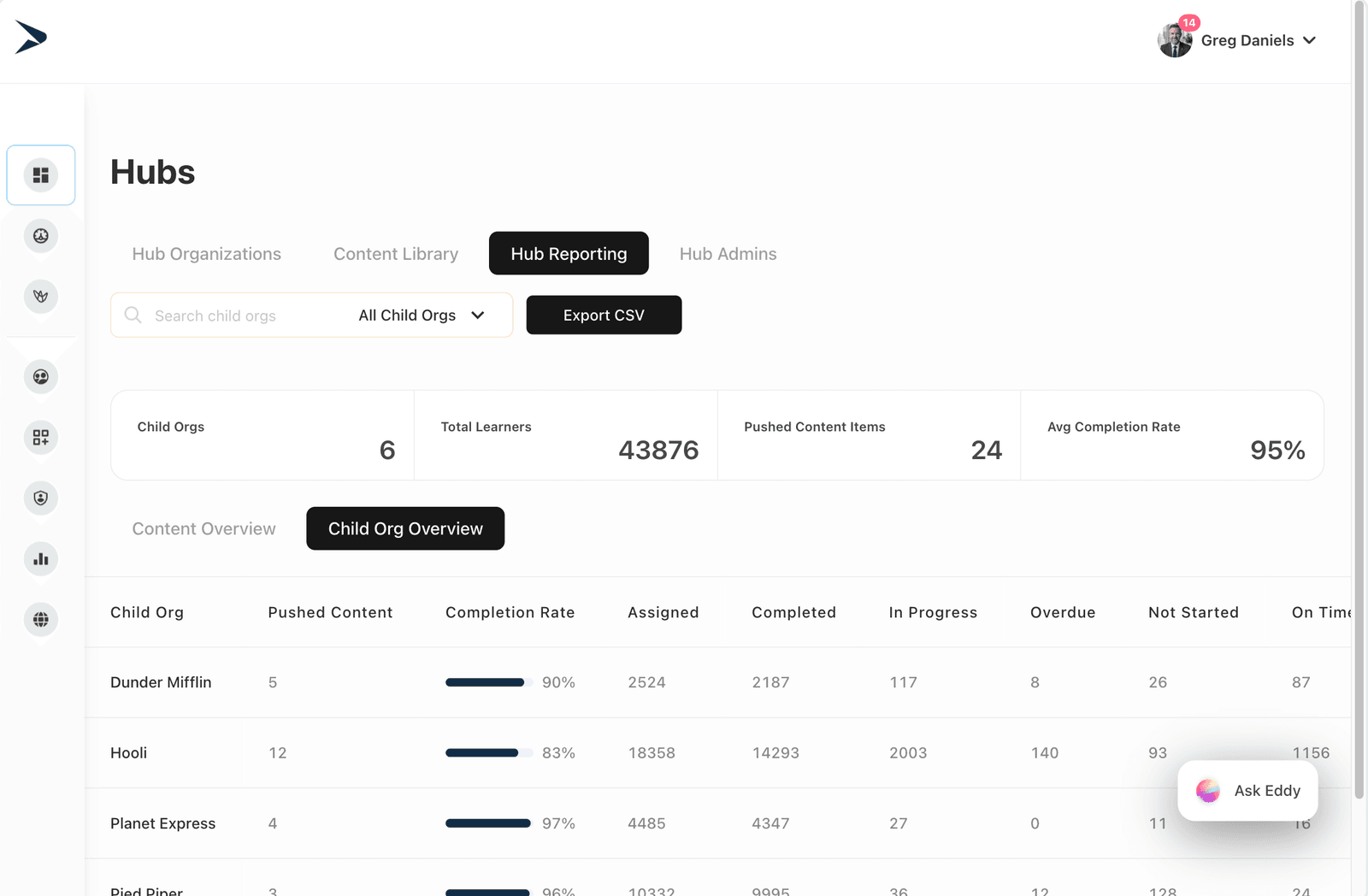
The rollup still exists, and it's worth having. What changes is where it sits: on top of that access rather than in place of it.
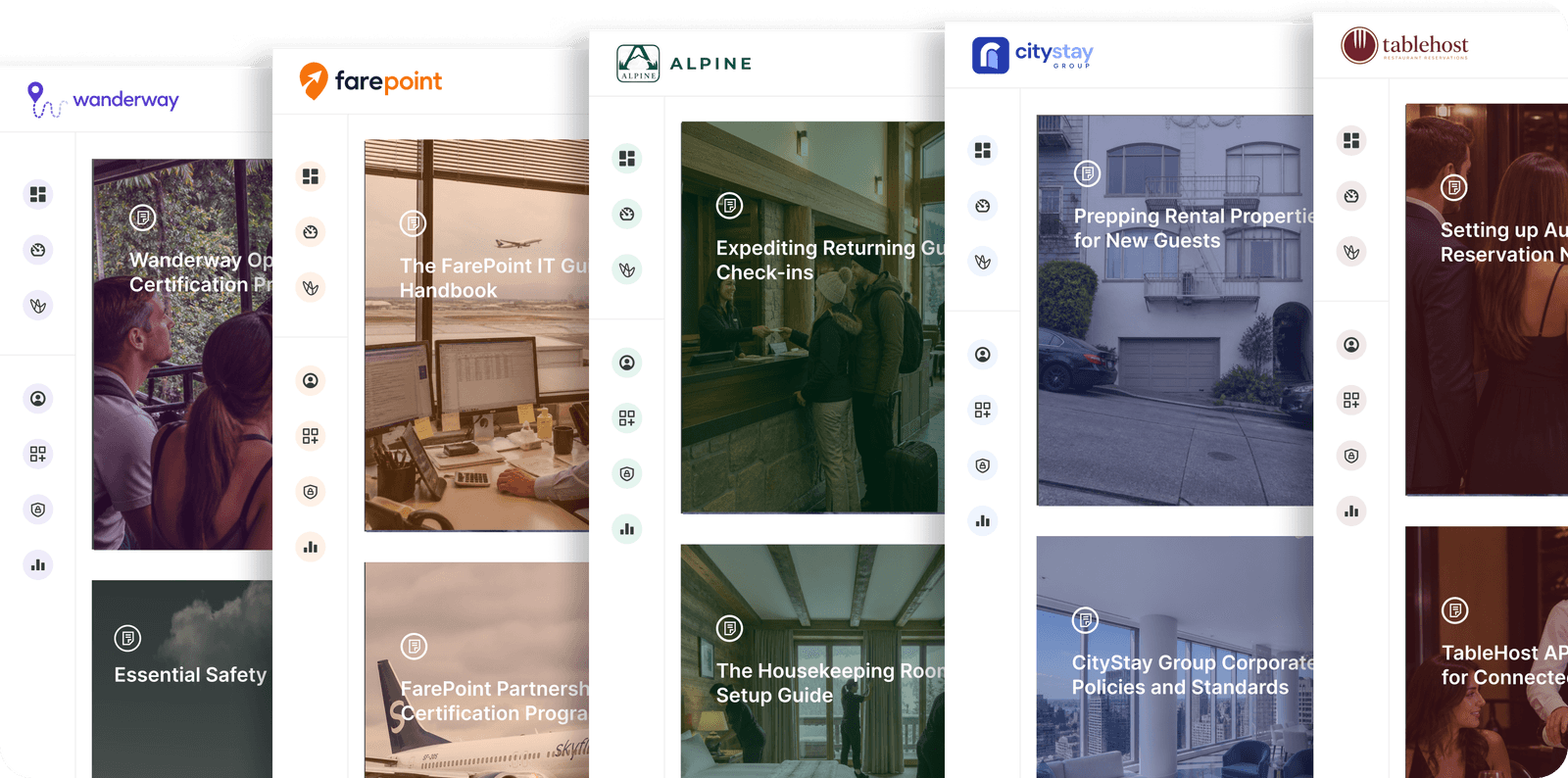
What each brand gets is a complete platform, not a permissioned slice of someone else's: its own branding, its own local admins, its own audience targeting through Smart Segmentation™. Two brands under one parent don't look like one system with two themes, because they aren't one system.
| The option | What corporate gets | What each brand gets |
|---|---|---|
| One shared system | One view, one standard | Someone else's branding, someone else's admin rules |
| Sub-portals in one instance | A rollup inside a single system | A feature-limited account, not a platform |
| Every brand buys its own | No rollup, no way in | A full platform, no shared floor |
| A federated model | A real account inside every brand's instance, plus a rollup on top of it | A complete platform of its own, branded and locally run |
Booking Holdings runs Booking.com, Priceline, Kayak, OpenTable and Agoda.
Each has its own market and its own way of working, and none of that bends to the corporate compliance and learning requirements that apply across the group whichever brand an employee sits under.
Before Continu, that corporate layer ran on a patchwork of separate learning systems with no shared view across any of them, and when the compliance and learning teams needed a picture of where the organization stood, it took outside BI support to stitch together what no single platform could show.
Force those brands onto one system and you lose the local identity each depends on.
Let each keep its own and corporate stays blind.
They chose the federated model instead: one parent Hub, with every brand keeping the platform experience and local control its team already knew.
When one shared system, permissions and all, is the right call
Two or three brands, low compliance complexity, low turnover, and genuine appetite from every brand to work in one place: a well-configured single system with proper role scoping is a reasonable answer at that size, and I'd rather that company spent its energy elsewhere.
What I'd want you to be honest about is the shelf life.
That setup holds until the fourth brand arrives, or until an acquisition brings a team with no intention of working inside somebody else's instance.
Brandon Hall Group, an independent analyst firm, found that 44 percent of companies with learning technology plan to replace it within two years.
A separate Brandon Hall study the following year found that the inability to integrate had overtaken poor user experience as the top barrier to satisfaction.
Permission scoping doesn't fail loudly.
It runs out of room, usually at the moment you're least able to stop and re-platform.
What this means for you
Three questions you can answer this week, without a vendor in the room.
First: can you see what's happening inside any one of your brands right now, without asking that brand to show you?
Not last quarter's number.
The live thing.
Second: does your parent organization hold a real account inside each business unit's own system, or only a report pulled out of it? If it's the report, you have reporting rather than oversight, and you'll learn the difference on the day it matters.
Third: if you acquire a brand next quarter, what does it get on day one?
A complete platform of its own, or a cut-down version of somebody else's?
That answer is your architecture, whether or not anyone wrote it down.
Oversight and autonomy were never the thing in conflict
What was in conflict was two architectures, each built to solve one half of the problem and each charging you the other half.
A federated model isn't the midpoint between them.
It's the one approach that never asked you to choose: corporate holds a real account inside every brand's own instance, and every brand runs a platform that belongs to it.
Related reading. Keith Martin on the fragmentation cost, in full. Terri James on why a report was never the fix. See the parent and brand view side by side in the self-guided tour.
Smarter training. Stronger teams.
See how thousands of enablement leaders around the world are automating delivery, increasing ROI, and creating real business impact with Continu.